


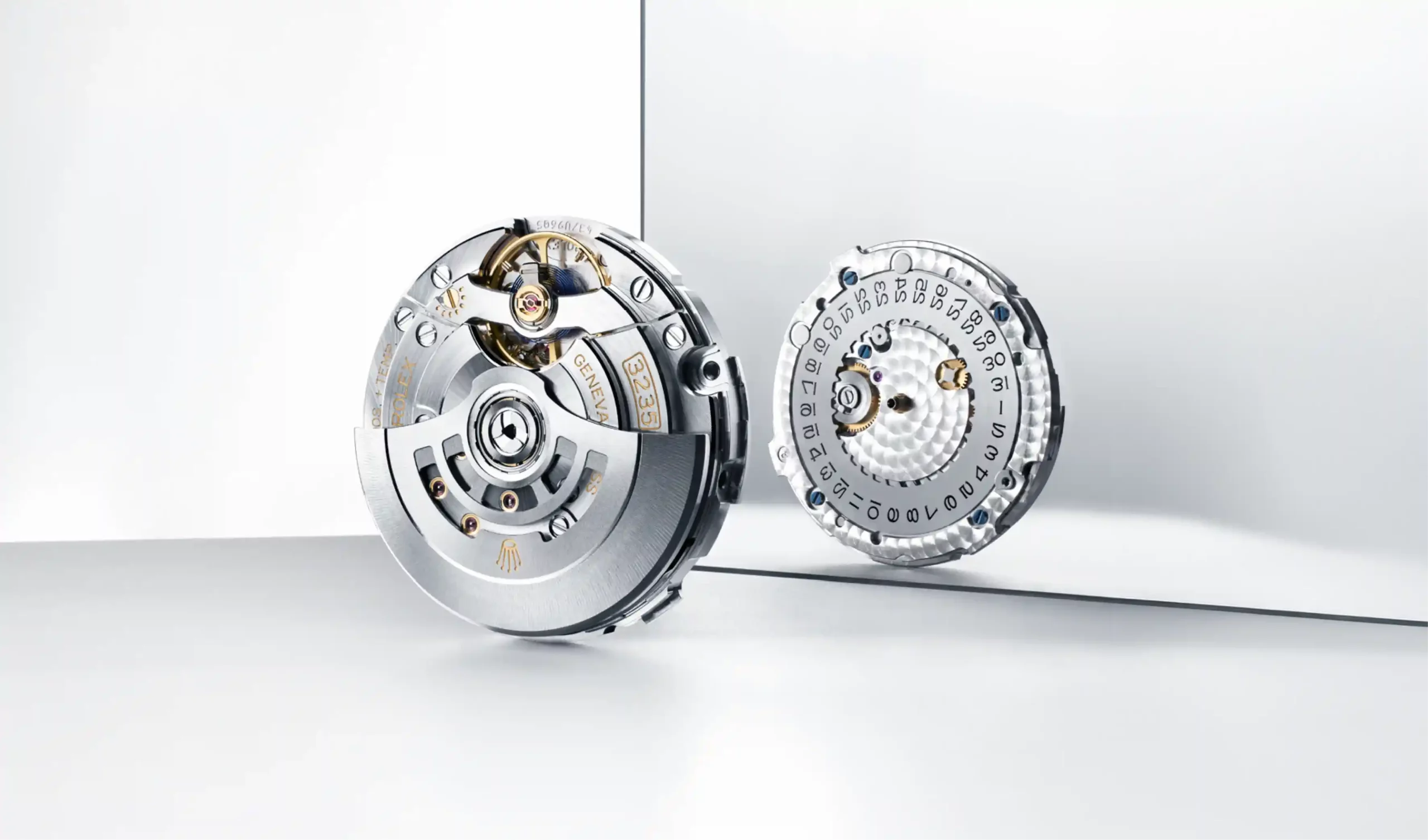
The Core Concept of a Mechanical Watch
A mechanical watch uses pure physics, which is very different from the modern quartz watches that use electrical batteries and microchips. The whole mechanism depends on tension, friction reduction, and precise mathematics. The system works through four steps:
- Power Storage
- Energy Transmission
- Regulation
- Time Display
The watch stops working if any single tiny part or component malfunctions. Here is how the internal movement of a mechanical watch functions.
Step 1: Power Generation and Storage
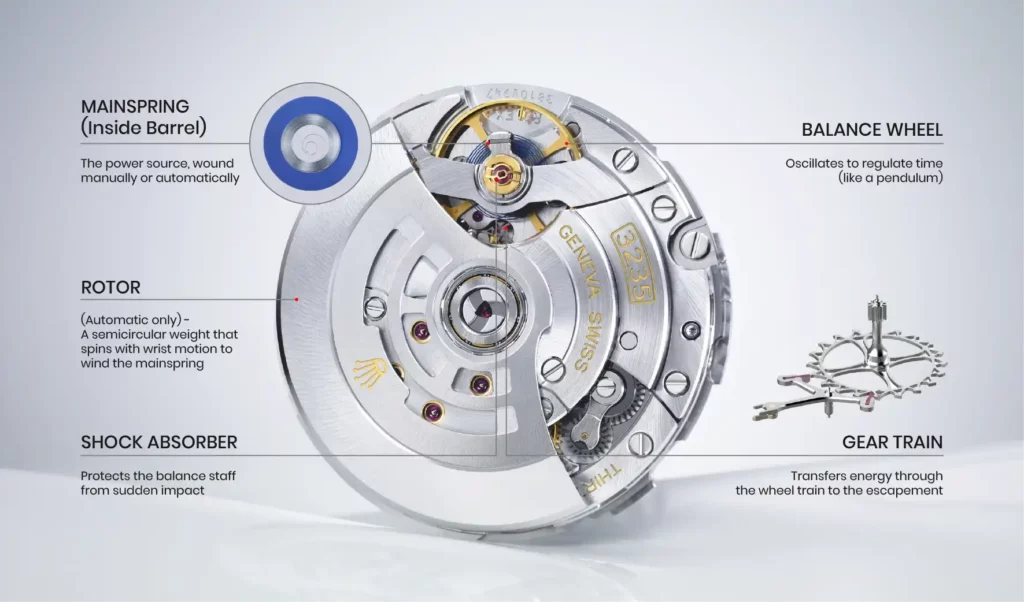
A mechanical watch needs a power source. Although there is no battery, the watch relies on mechanical tension, which is created inside a small cylindrical drum called the barrel. The barrel has the mainspring, which is a very long and thin ribbon of a special elastic metal coiled up very tightly.
When you wind the watch, you force this spring into a tighter coil. As the spring tries to uncoil and expand back to its relaxed shape, it pushes against the inside wall of the barrel. Thus, this push creates rotational force or torque. The outside of the barrel has gear teeth, so when the barrel slowly turns, it drives the rest of the watch.
There are two ways this spring gets coiled:
- Manual Winding: You use your fingers to twist the crown on the outside of the watch case, which physically turns the internal winding gears to tighten the spring.
- Automatic Movement: The watch has a heavy, half-circle metal weight called a rotor. Gravity makes the rotor swing in circles when you wear the watch and move your wrist. The swinging motion connects to a gear system, which winds the spring automatically.
An Expert Tip: A common mistake our watch expert, Mr. Aiman Moner, sees watch owners make is violently shaking a dead automatic watch to force the rotor to spin. This puts unnecessary shock on the central rotor bearing. The best practice is to give the crown 10 to 15 manual turns to establish a baseline torque inside the barrel, and then let your natural wrist movements do the rest of the winding throughout the day.
The amount of time the mechanical watch can run on a fully coiled spring is called the power reserve. Usually, this lasts between 38 and 72 hours.
Step 2: Energy Transmission (The Gear Train)
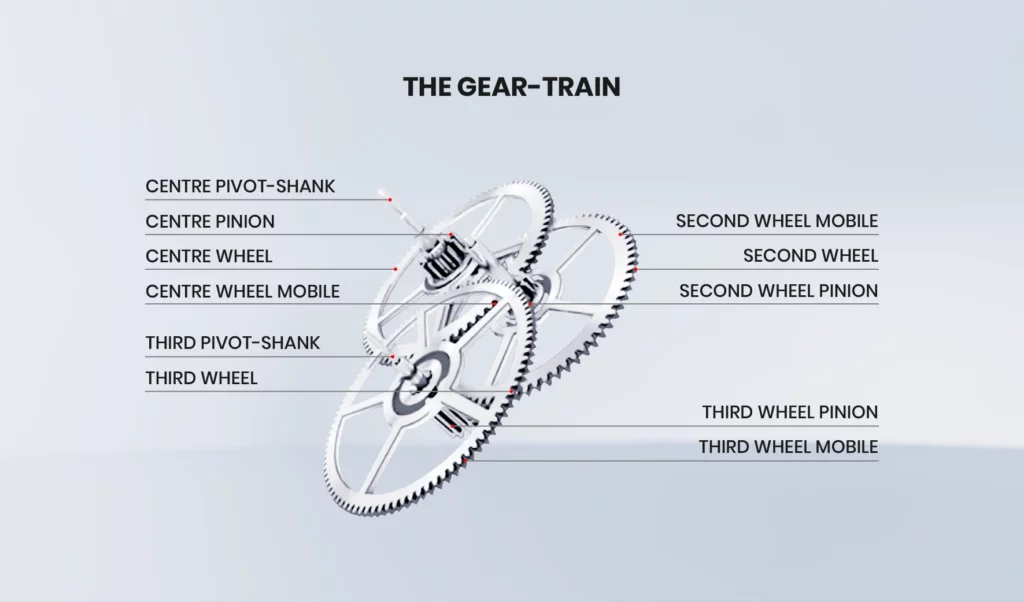
The barrel turns very slowly. If we attach watch hands directly to the barrel, the watch won’t display normal time. Remember, the raw energy from the spring is very strong. A mechanical watch needs a way to step up the speed of rotation while reducing the raw pulling force. So, this is where the gear train comes into play.
The gear train consists of multiple interlocking brass or steel wheels and small steel pinions. The teeth on the outside of the main barrel turn the center wheel, which turns the third wheel, and the third wheel turns the fourth wheel. Each gear connection is a mathematical ratio. For instance, mechanical watch brands usually design the central wheel in a way that it rotates exactly once every 60 minutes. The fourth wheel is calculated to rotate exactly once every 60 seconds.
Metal-on-metal contact would destroy the watch very fast because these small gears spin constantly under high pressure. That’s why expert watchmakers use tiny synthetic rubies to solve this issue. These red stones are hard and smooth, and watchmakers place them at the ends of the gear axles, also called pivots or jewel bearings. These ensure the gear train spins with almost zero friction.
Step 3: Time Regulation (The Heartbeat)
Think of the watch mechanism like a large water dam. The coiled mainspring is the big reservoir holding back massive amounts of water. If the dam breaks, the water rushes out in a violent flood. If we leave the gear train alone without a brake system, the mainspring uncoils completely in just a few seconds. The watch hands will spin violently fast until the power dies.
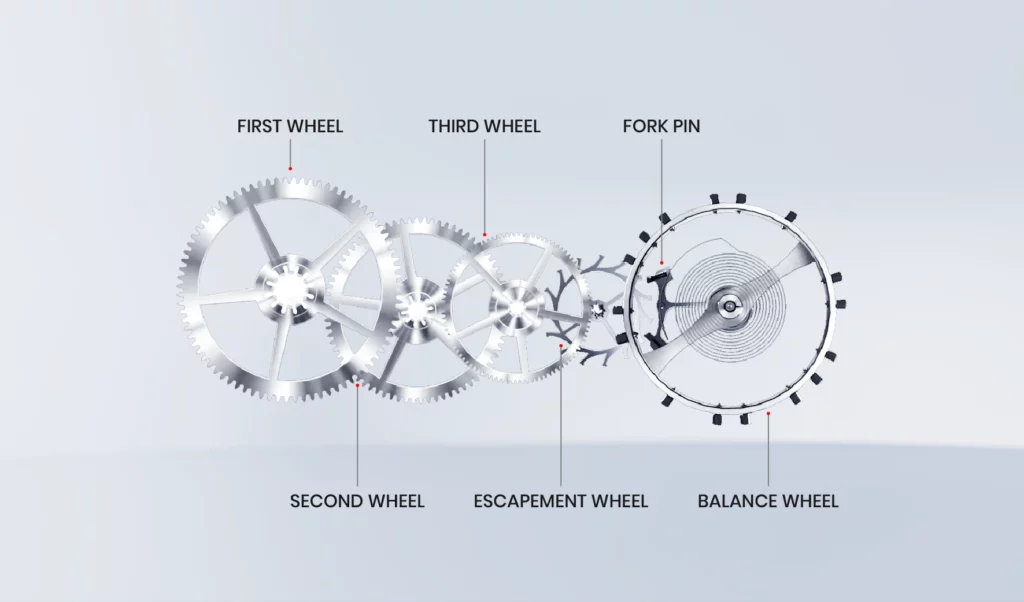
The watch needs a brake system to control the release of power. Remember, this happens at the regulating organ, which consists of the escapement and the balance wheel. They act as a microscopic valve to release the power exactly one drop at a time.
The Escapement
The energy from the last gear in the train pushes the escape wheel. Next to the escape wheel is a small metal piece called the pallet fork, which has two tiny ruby stones on its arms. It locks into the teeth of the escape wheel, completely stopping the watch.
The Balance Wheel and Hairspring
A mechanical watch uses a balance wheel to unlock the pallet fork. It is a small, weighted wheel that swings back and forth. Inside the center of this wheel is a microscopic, oscillating spring called a hairspring. When the balance wheel swings one way, a small pin on its roller hits the pallet fork, moving it out of the way and unlocking the escape wheel.
Next, the escape wheel jumps forward by exactly one single gear tooth. As it jumps, it transfers a tiny physical push back to the pallet fork, which pushes the balance wheel to keep it swinging. Then, the hairspring pulls the balance wheel back in the opposite direction, and the process repeats. Every time the ruby stones lock and unlock the escape wheel tooth, it makes a sharp sound. And this is the famous “tick-tock” sound you hear when you put the watch to your ear.
Beat Rate
A beat rate refers to the speed of these swings. A common modern watch swings 28,800 times per hour, which equals 8 ticks every single second, and this microscopic gating of power is what keeps the time accurate. According to Aiman Moner, our watch expert at ChronoStreet,
I notice stark visual differences in these beat rates on the workbench. For instance, a reliable workhorse movement like the Seiko 4R36 beats at 21,600 times per hour, producing 6 ticks per second, which gives the seconds hand a slightly stuttered sweep.
Aiman also points out that higher-end Swiss movements like the Rolex Caliber 3235 or the popular ETA 2824-2 run at 28,800 bph.
Opening the caseback and watching that faster heartbeat under a loupe is fascinating. But it also means those faster gears demand premium synthetic watch oils, such as Moebius 9010, to survive the constant, high-speed friction without burning out.
Step 4: The Motion Works and Display
Now the mechanical watch has accurately controlled and measured rotational energy. The final step is to show this to the user. The movement connects to a separate set of gears located under the watch dial, and this system is called the motion works.
The “motion works” take the regulated rotations from the center wheel and the fourth wheel and then translate them to the hour, minute, and second hands.
The hands are fixed to the center posts or pinions of these gears, which causes them to sweep across the dial at the exact right speed. Thus, this allows you to read the precise time.
Also Read: Mechanical or Smart Watches: Which one’s easier to maintain?
Frequently Asked Questions (FAQs)
Why do mechanical watches lose or gain a few seconds every day?
Older steel hairsprings used to expand in hot temperatures and contract in the cold, drastically changing the beat rate. Even though modern watchmakers now use advanced anti-magnetic alloys like Nivarox or pure silicon (Silinvar) to fight temperature changes, the watch is still at the mercy of physical gravity. Gravity pulls harder on the balance wheel depending on the angle of your wrist while you sit at a desk or walk. All these tiny physical variables combined cause even a luxury mechanical watch to deviate by 2 to 4 seconds per day.
Do I ever need to replace a battery in an automatic watch?
No. An automatic movement never needs a battery. As long as you wear it, the kinetic energy from your arm movements spins the rotor and coils the mainspring. If you leave the watch on a table for a few days, it will stop. You only need to pick it up, shake it gently or turn the crown, and set the time again.
Why do luxury watch brands write “21 Jewels” on the dial?
The word “jewels” refers to the synthetic rubies used as jewel bearings inside the gear train and escapement. These are not natural diamonds or gemstones meant for decoration. A standard hand-wound watch needs about 17 jewels to protect its moving parts from friction. Automatic watches often use 21 or more jewels because the rotor winding mechanism has extra gears that also need friction protection.