

The Myth of the “Universal Lubricant”
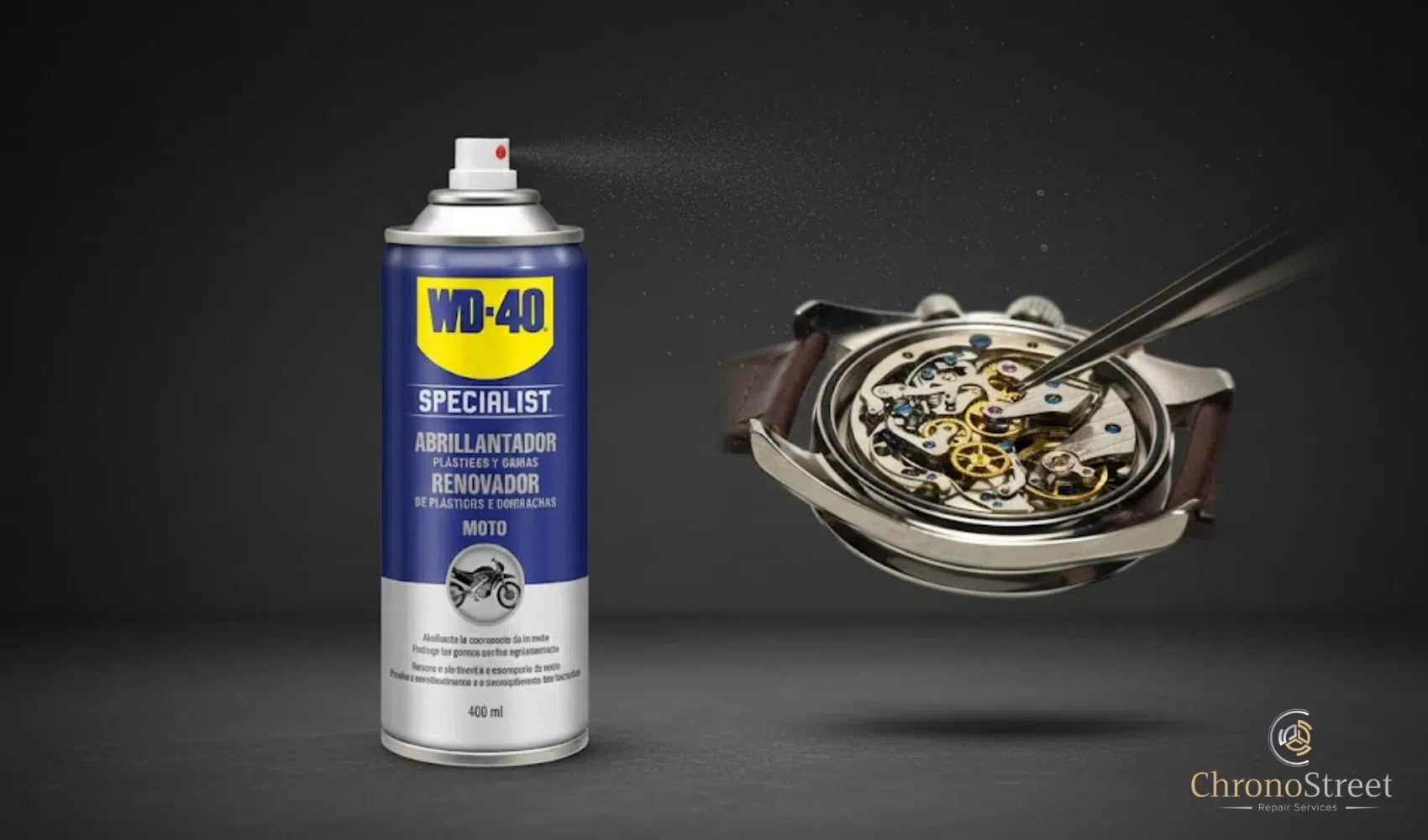
First, we must correct a big misunderstanding. WD40 stands for “Water Displacement, 40th Formula.” It was invented in 1953 for the rocket industry to prevent corrosion on missile skins, which means it was not for lubricating tiny and high-speed gears. Its main ingredients are solvents, like aliphatic hydrocarbons, and a very tight mineral oil.
In addition, when you spray it, it feels slippery. Thus, this tricks you. You think kit is lubricating, but in reality, the solvent dissolves rust and gunk. Once the solvent evaporates, which happens very fast, what is left behind is not a smooth oil. It is a sticky and thin residue. Although this is fine in a door hinge, this is a disaster in a watch movement with tolerances of 0.01 millimeters.
Why WD40 Kills Watch Movements
There are three main reasons why WD40 kills watch movements:
The Formation of Abrasive Slurry
A watch movement must be clinically clean, and when we service a watch, we wash it in three different chemical baths before adding a single drop of oil. WD40 does the opposite because it is a magnet for dust. When the volatile solvents in WD40 fly away, they leave a tacky film.
In addition, this film catches microscopic dust, metal particles, and lint from the air. So, this mixture of sticky oil and dust forms a black sludge. Instead of floating the gears on a cushion of oil, this slurry acts like liquid sandpaper, which eats away the steel pivots of the balance staff and the brass of the mainplate. A watch running on WD40 is literally grinding itself to death.
Capillary Action: The Oil that Wonders
In watchmaking, we fight a battle against gravity and surface tension. We use a special treatment called epilame to stop oil from spreading. Remember, we want the oil to stay exactly in the jewel cup. We don’t want it to run away. WD40 has very low surface tension and low viscosity, which means it has high capillary action. Therefore:
- It will not stay on the pivots.
- It will crawl along the bridges.
- It will seep onto the hairspring, sticking the coils together and causing galloping.
- It will creep onto the dial and hands.
WD40 stains paper and painted dials permanently. Therefore, oil migration can run a vintage dial worth $500 in minutes.
Destruction of Gaskets and Shellac
Watches use rubber gaskets to keep water out, and many of these gaskets have materials that degrade when touched by petroleum distillates found in WD40. The gaskets will swell, turn into a black goo, and lose all water resistance. Even more dangerous is the effect on Shellac.
For instance, the pallet stones, which are two red rubies that tick-tock against the escape wheel, are glued in place with shellac. Strong solvents can soften this glue, and when it shellac softens, the stones shift position. As a result, the escapement unlocks at the wrong time, and the watch stops dead.
Also Read: Water Damage in Watches: How Bad it Can Get?
The Chemistry Comparison: WD40 vs. Watch Oil
| Feature | WD40 | Moebius 9010 (Watch Oil) |
| Primary Function | Water displacement and rust removal | Friction reduction and longevity |
| Base | Mineral Spirits or Hydrocarbons | Synthetic Synt-A-Lube |
| Viscosity | High (Dries out quickly) | Specific (Medium-light) |
| Spread | High (Creeps everywhere) | Low (Stays where placed) |
Real watch oils, like Moebius 9010 or HP 1300, are synthetic engineering oils, which don’t gum up and evaporate. Thus, they stay liquid and slippery for years. On the other hand, WD40 turns into a varnish-like glue within weeks.
You Already Sprayed it – What Now?
Do not panic if you have sprayed WD40 into the watch movement. But also, don’t wait because the longer it sits, the more damage the solvents do to the dial and shellac. Don’t run the watch, and pull the crown out to stop the movement if possible.
Remember, you can’t fix this by wiping it with a cloth because the spray has penetrated the pivots, which are the tiny axles of the gears. Therefore, this requires full disassembly, and you must take apart the watch completely, including every screw, bridge, and wheel. Next, clean the parts in a proper degreaser. Keep in mind that professional watchmakers use ammoniated cleaners in ultrasonic machines.
But if you are a hobbyist, you can use 99% Isopropyl Alcohol or Naphtha (lighter fluid), but make sure you give the parts multiple baths to strip away the WD40 film. You must also clean the jewels or rubies manually with sharpened wood or pegwood to push out the gummy residue from inside the hole. Only after it is bone dry and clean can you reassemble and oil it with the correct lubricants.
If you are uncomfortable taking the watch apart into its individual items, you must take it to a watchmaker. Be honest with our expert and tell him, “I sprayed WD40.” Our watch repair experts know exactly how to save the parts before the damage becomes permanent.