

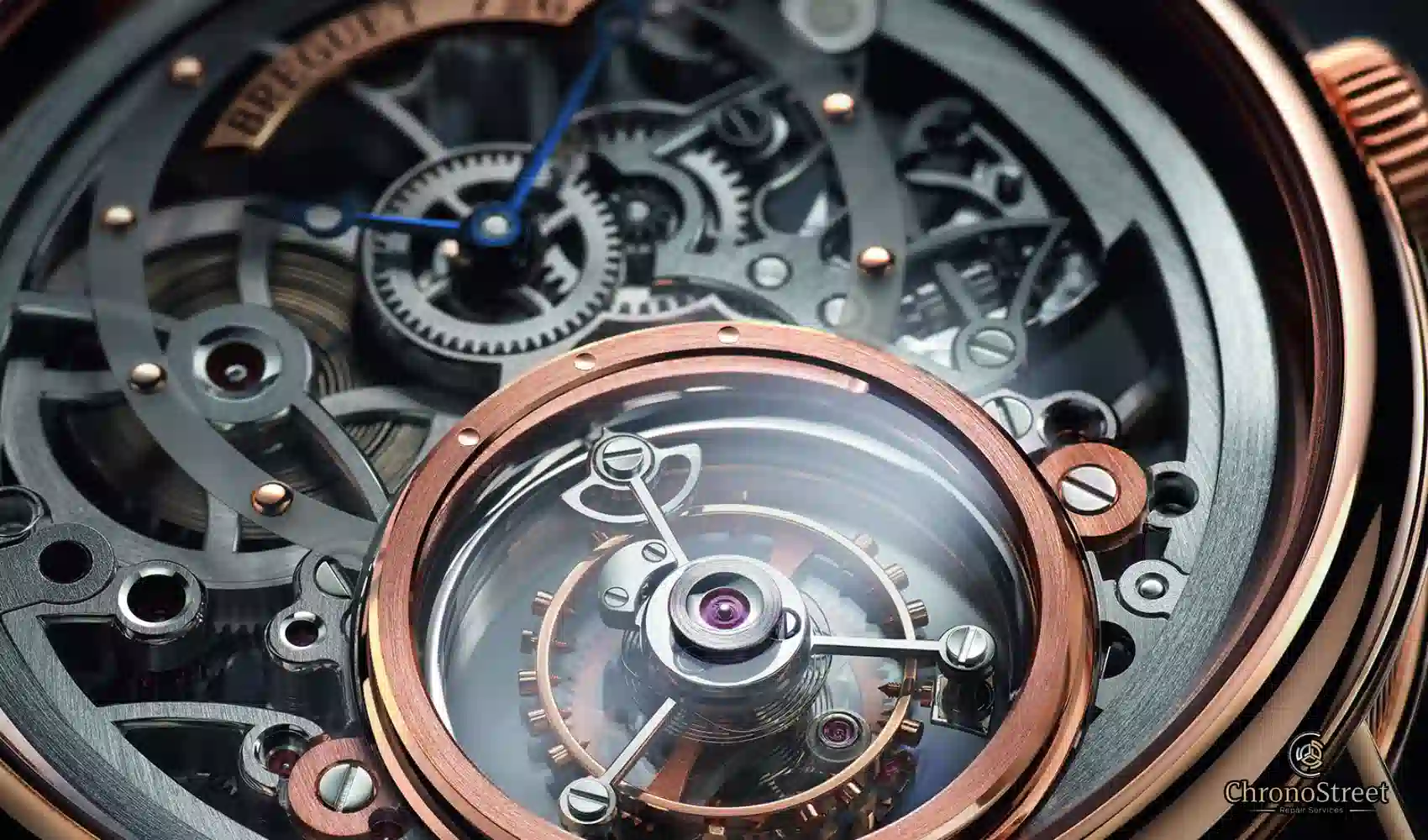
I remember the first time I held a tourbillon watch in my hand. The case felt heavy with gold, but when I turned it over and looked through the clear back, there was a shining cage rotating once every minute. It made me think: why do watchmakers still make this complicated thing today?
The History of Tourbillon Watches
Abraham-Louis Breguet was a very intelligent French-Swiss watchmaker who got a patent for the tourbillon in 1801.
Tourbillon means whirlwind in French. The most luxurious timepieces in the early 1800s were pocket watches, and people would keep them in their waistcoat pockets. Thus, this would cause the watch to stand almost always in the same vertical position.
Gravity pulled down on the balance wheel and the thin hairspring inside. One side became a little heavier, or the spring bent a tiny bit, so the watch ran faster or slower depending on its position.
Breguet had the idea of putting the whole escapement, including the balance wheel, the hairspring, the pallet fork, and the escape wheel, inside a round cage.
The cage turned slowly and fully at 360 degrees every minute, which caused the errors from gravity to average out over time.
Therefore, the watch would not care so much about position anymore. Moreover, Breguet did not make hundreds of tourbillons and only sold 35 watches between 1805 and his death in 1823.
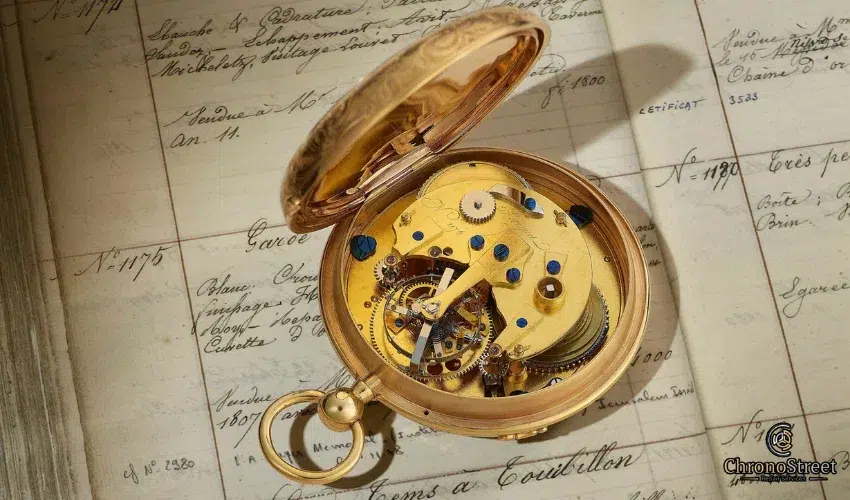
However, the watches were expensive because he would make them for kings and rich collectors. One example from that era still exists with a beautiful enamel dial and handwritten notes from Breguet himself.
Today, these historical watches are in museums or private collections. These watches are worth millions.
How Does the Tourbillon Actually Work?
Power comes from the mainspring in the barrel of a normal mechanical watch. It goes through the gears to the fourth wheel and then to the escape wheel, which pushes the balance wheel back and forth.
The balance swings at a steady rate, which is usually 28,800 times per hour in modern watches. Thus, this keeps the time.
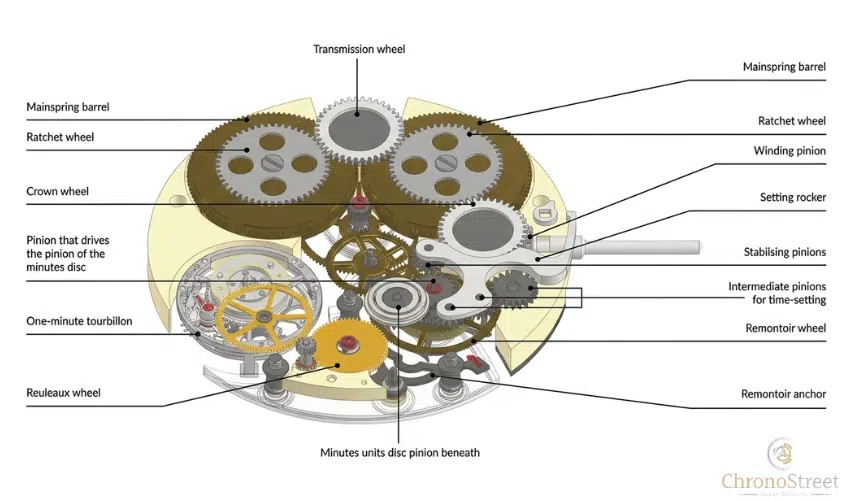
On the other hand, the escape wheel, lever, and balance are inside a cage in a tourbillon. The cage has its own pinion at the bottom, and the going train drives a fixed fourth wheel with teeth on the outside.
The pinion on the cage walks around this fixed wheel like a planet around the sun. And as the cage turns, the escape wheel inside still gets power because its pinion is rolling around the stationary fourth wheel teeth.
Every beat of the balance locks and unlocks the escape wheel exactly as normal. However, the whole group spins now.
The rotation changes the direction of gravity on every part every second. Small mistakes in poising, such as the perfect balance of the wheel, or in the shape of the hairspring, get cancelled out.
Remember, the cage itself must be super light. Top watchmakers keep it under 0.3 or 0.4 grams. Companies use titanium or special alloys.
Every bridge and screw is hand-polished, so there is almost no extra friction. Lubrication is tricky because the parts move in a circle, and the oil spreads differently than in a fixed movement.
Quality tourbillons need service every three to five years. Many tourbillons rotate once per minute, so the cage can act as a second hand if you watch it. Likewise, some modern ones turn faster or slower for different looks.
Different Kinds of Tourbillon You Can Find Today
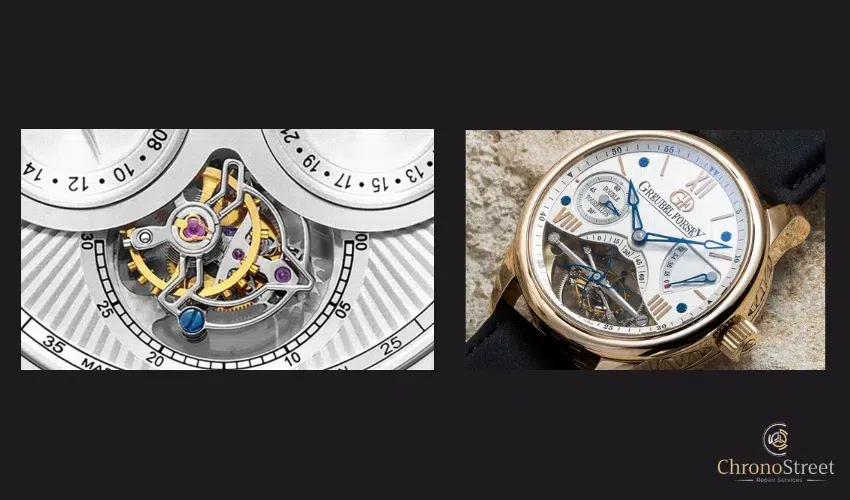
Not all tourbillons are the same, and watchmakers love to improve the idea.
- Classic One-Minute Tourbillon: The original style of tourbillon, which is still very common.
- Flying Tourbillon: It has no upper bridge above the cage. It looks like it floats in the air, supported only from below. Alfred Helwig invented this in 1920 in Glashütte, Germany. Today, you see it in many luxury watches because it shows more than mechanism.
- Double Tourbillon: It has two cages inside each other. One famous double tourbillon is from Greubel Forsey, in which the inner cage tilts at 30 degrees and spins every minute, and the outer one turns every four minutes. Watchmakers say this fights gravity even better in all positions.
- Triple or Multi-Axis: Jaeger-LeCoultre made the Gyrotourbillon with two or more axes spinning at different speeds. These are thick and very rare.
- Karrusel: Bahne Bonniksen invented the Karrusel tourbillon. It rotates more slowly because the third wheel drives it, and not the fourth wheel. Some people mix Karrusel and Multi-Axis, but they are different.
Does It Really Make the Watch More Accurate?
Everyone asks this important question. A tourbillon has helped a lot in pocket watches of the 1800s. Observatory tests showed very small differences between hanging and flat positions.
But on the wrist? It is more complicated. Your arms move all day, up, down, and sideways. The wrist itself acts like a natural tourbillon.
Modern materials help too. For example, silicon hairsprings don’t change with temperature or magnetism. Likewise, today, companies use special alloys for making balance wheels.
Many experts, like the late George Daniels, said that a well-made normal movement can keep time as good or better after years of use. A tourbillon uses more power, so the power reserve can be shorter. It is also harder to adjust due to the extra moving mass.
However, some high-end tourbillons win chronometry contests even today. The Greubel Forsey double tourbillon got top scores in 2011. But for daily wear, a good automatic watch from Rolex or Omega without a tourbillon usually beats cheap tourbillons in real life.
So, why buy one? Because it is beautiful. Because it shows the watchmaker spent hundreds of hours finishing every tiny part by hand. And because when you look at your wrist and see that cage turning, you feel you own a piece of horological art.
Why Tourbillon Watches Cost So Much?
Manufacturing a tourbillon watch is extremely difficult. The cage must be perfectly round and balanced, and assembly takes days under the microscope. Only a few experts in Switzerland or Germany can do it well.
Prices start from around $3,000 to $5,000 for simple Chinese-made movements. For example, Seagull makes good tourbillons that many brands use.
Quality Swiss entry-level watches, such as Frederique Constant or TAG Heuer, cost $15,000 to $30,000. Top brands, including Breguet, Audemars Piguet, Patek Philippe, and Vacheron, can go over $100,000.
Unique pieces from Greubel Forsey or Philippe Dufour can reach half a million or more. But remember, the price is not only for accuracy. In fact, it is for the story, the craft, and the joy of owning something rare.
Modern Examples That People Love
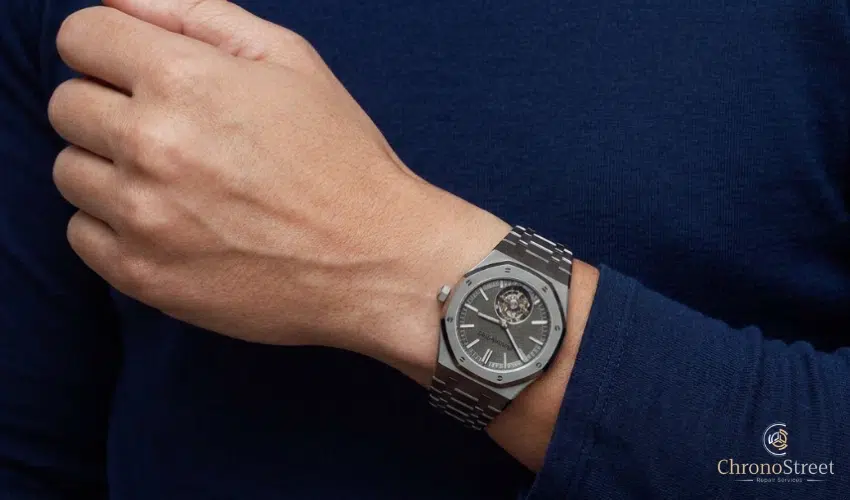
- Audemars Piguet Royal Oak flying tourbillon in titanium is sporty and light. It is perfect for daily wear.
- Breguet Classique with visible tourbillon at 6 o’clock is elegant and true to the inventor.
- Greubel Forsey pieces look like sculptures.
Even some accessible brands now offer skeleton tourbillons, so you can see everything working. If you are thinking of buying one, ask yourself: Do I want it for the looks and the feeling, or only for better timekeeping? Most owners say the first.
In the end, I would say a tourbillon watch is more than a tool to tell time. In fact, it is proof that people still love pure mechanical beauty even in our digital world.
The little whirlwind inside keeps turning and reminds us of the genius Mr. Breguet, more than 220 years ago. If you ever get a chance to see one up close, stop and watch for a minute. You will understand why collectors can’t resist tourbillon watches.