

The Good Rattle vs. The Bad Rattle
Before you panic, you must understand that an automatic movement is a machine in motion. It is not silent. The self-winding mechanism relies on a heavy, semi-circular weight, which allows the rotor to spin freely and generate energy.
The Characteristic Rotor Noise is Normal
Some movements are famous for their acoustic presence:
The Valjoux Wobble: If you own a chronograph powered by the Valjoux 7750 or its variants, like the ETA 7750, you will usually feel a “wobble” on your wrist and hear a loud whirring sound. Remember, this is due to the movement that winds in only one direction. So, when the rotor spins in this non-winding direction, it free-wheels at high speed and creates an entirely normal noise.
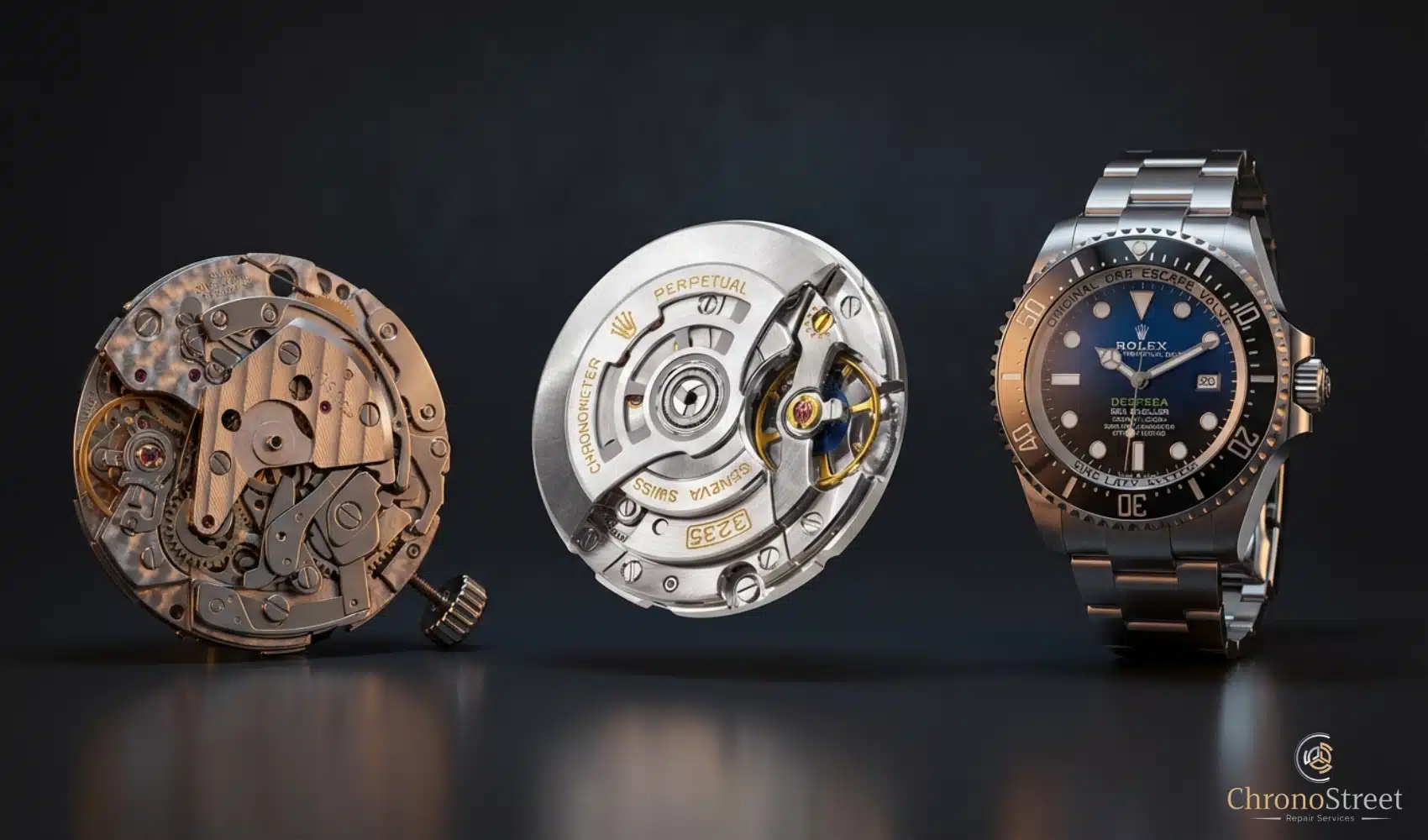
Ceramic Bearings: Modern luxury watch calibers, such as the Rolex 3235 or the Patek Philippe 324 S C, use ceramic ball bearings for the rotor axle. Ceramic bearings can get unlubricated and produce a dry, zipping sound, unlike the older Rolex 3135, which used a greased metal axle (it was silent). Anyways, the ceramic bearings are a durability feature in modern watches, which means it is not a defect.
The Death Rattle Noise is Abnormal
A problematic sound is different. For example, it is not a smooth “whir” but rather a sharp and metallic “clack,” “tink,” or “scrape” sound. Therefore, your watch likely has a loose component if the sound occurs even when the rotor is not spinning, or if it sounds like a small pebble is tumbling inside the case.
5 Primary Causes of Rattling Sounds in Automatic Watches
If you have determined that the sound is not the normal operation of the automatic winding module, it is likely one of the following issues:
A Loose Rotor
The most common cause of a heavy rattling sound is the oscillating weight itself becoming loose.
- The Anatomy: A single central screw or a ball-bearing assembly attaches the rotor to the movement bridge.
- The Failure: Vibrations or a sudden shock, such as dropping the watch, can cause the rotor screw to back out slightly over time.
- The Symptom: When this happens, the rotor no longer rotates on a flat plane. Instead, it tilts and scrapes against the case back or the movement bridges. You will hear a different sound of metal-on-metal, usually followed by a “clunk” as the rotor hits the case.
For instance, the rotor spins on a jeweled axle on a Rolex 3135, and if this axle wears out due to lack of lubrication, the rotor will wobble and eventually rub against the mainplate and create a groove. So, this is a costly repair called the “Rotor Rub.”
Loose Movement Clamp Screws
Movement clamps or tabs and screws secure the movement inside the watch case and ensure the dial stays centered and the movement does not shift. If a movement clamp screw loosens, the head of the screw can break off, or the screw itself can fall into the mechanism. So, this creates a very different “tinking” sound like a small piece of debris bouncing around. Unlike a loose rotor, this sound is lighter and sharper. If this screw migrates into the balance wheel or the gear train, it will instantly stop the watch and snap the pivots of the wheels.
Worn or Broken Ball Bearings
Movements that use ball bearings, like the ETA 2824 or Omega Co-Axial calibers, the rotor spins on a race of tiny steel or ceramic balls. If the bearings are steel, they can rust or wear down if moisture enters the case, and if the case holding the balls collapses, the balls can cluster together. Therefore, you will hear a crunchy or grinding noise when the rotor spins. It won’t spin freely and may get stuck, which significantly reduces the power reserve because the watch is not winding efficiently.
The Reversing Wheels Cause the Grinding Sound
Many automatic watches have reversing wheels, which rectify the motion of the rotor to wind the mainspring barrel regardless of which way it turns. These wheels run or work under high stress. For example, the red anodized reversing wheels in the Rolex 3135 can lose their lubrication. In addition, a dry reversing wheel will make a zipping or light grinding noise. Although this is not a rattling sound in the traditional sense, most people consider it rattling. However, it indicates that a service or overhaul is overdue.
Bracelet End Links
Check the outside of your watch before you send it to a service center. The spring bars that hold the bracelet to the case can wear out, or the end links, which are metal pieces connecting the bracelet to the watch head, can become loose. Thus, this creates a clicking or rattling sound when you shake your wrist. You can test this by holding the bracelet firmly against the case with your fingers and shaking the watch again. The movement is fine if the silence returns. However, you need new spring bars or a bracelet adjustment.
Also Read: Causes of Amplitude Issue in Rolex 3235 Movements
How to Identify the Source of a Rattling Sound Inside an Automatic Watch?
You can perform a basic diagnosis at home without opening the case, which you should never do unless you are a trained watchmaker.
- The Position Test: Hold the watch dial up and tap the side of the case gently. Then, turn the watch dial down and tap again. If the rattle is significantly louder in one position, it usually means a loose rotor scraping against the case back.
- The Winding Test: Unscrew the crown and manually wind the watch. Does it feel gritty, or do you hear the rattle while winding? If yes, the issue is in the keyless works or a loose screw trapped near the winding stem.
- The Visual Check: If your watch has a sapphire case back, like many Omega or Patek Philippe models, look at the rotor. Does it rotate parallel to the movement, or does it tilt? Likewise, look for any small screws floating where they should not be.
When to Seek Professional Help
A rattling sound inside an automatic watch is rarely something that fixes itself.
- Enjoy the sound of the character of the watch, whether it is the Valjoux wobble or the zipping of ceramic bearings.
- Stop wearing the watch immediately if it is a metallic clack, scrape, or loose debris.
- Pull the crown out to the time-setting position to stop the movement if it has hacking seconds, and bring it to ChronoStreet, our certified watch repair services.
Running a watch with a loose screw is like running a car engine with a loose bolt in the cylinder, which causes collateral damage to the bridges, gears, and hairspring, and can turn a simple repair into a complete movement replacement. Your luxury watch is an instrument, which means you should treat its sound as its language because it tells you exactly what it needs.