

The Misunderstanding of Static and Dynamic Pressure
Moving your arms underwater creates massive dynamic pressure that ruins standard watches. Fluid dynamics calculations using Morison’s equation show this is mostly false.
Therefore, moving your arm fast underwater only adds the equivalent of about 1.3 meters of pressure. Thus, this uses up only 1.3% of a 100M rating.
Dynamic pressure is not the primary reason watches flood. The real reasons are the testing standards and the aging of internal parts. Most everyday watches are tested under the ISO 22810 standards.
It involves testing the static pressure in a laboratory environment on newly manufactured samples. Remember, this standard or test does not simulate years of use.
30M Can Only Survive Light Splashes
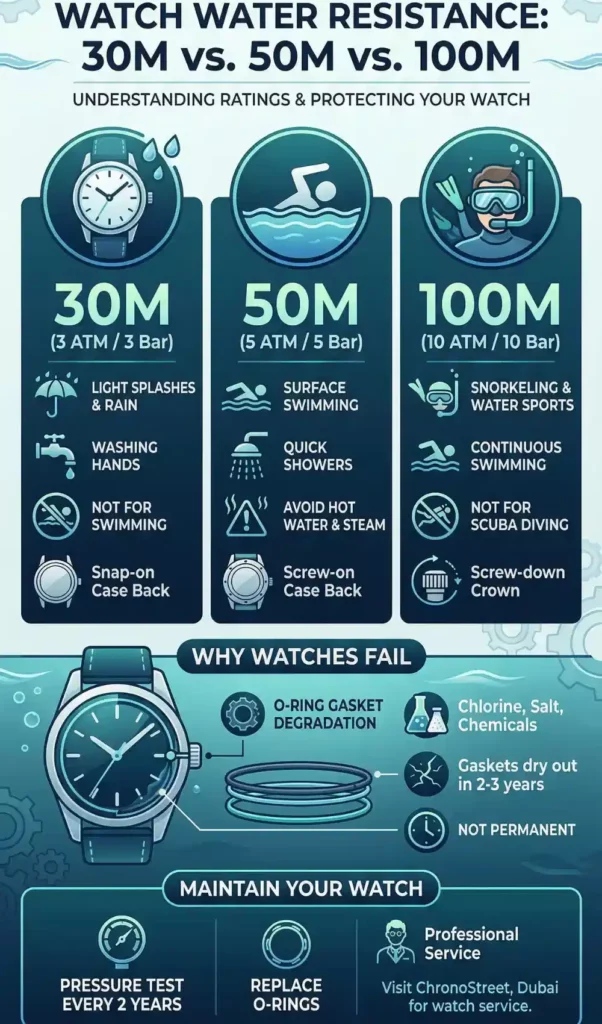
A 30M rating or 3 Bars is the lowest standard level. These watches usually use basic Snap-On case backs. The seal relies on low-level friction and thin gaskets. So, the watch is safe if you wash your hands or walk in the rain.
However, if you submerge it in a pool, water will bypass the thin rubber seals. Snap-on backs are highly vulnerable to minor impacts, and even a slight knock can deform the case slightly, allowing water to get inside. Therefore, you must never swim with a 30M watch.
50M (5 ATM or 5 Bar) is Suitable for Light Surface Swimming
A 50M watch offers better protection. Manufacturers usually upgrade the case design to a screw-on case back. You can wear it for brief surface swimming. However, temperature changes are dangerous for 50M watches.
Taking a hot shower or entering a hot tub causes the metal case and the rubber O-rings to expand at different rates. In addition, the thermal shock opens micro gaps. Steam is a gas, so it easily enters these gaps and condensates under the watch crystal when you step back into a cool room.
100M (10 ATM or 10 Bar) is for Snorkeling and Water Sports
A watch becomes practical for continuous water sports at 100M. These watches usually feature screw-in case backs, thicker crystal gaskets, and sometimes screw-down crowns. You can safely use them for snorkeling, surfing, and pool swimming.
However, a 100M everyday watch is not a certified dive watch. Remember, Dive watches must pass the separate ISO 6425 standard, which requires testing every single watch in water at 125% of its rated pressure.
It also includes strict condensation tests and thermal shock tests. A standard 100M watch only passes the basic ISO 22810 test on a random sample batch. Don’t use a standard 100M watch for Scuba diving.
The Real Reason Watches Fail is O-Ring Gasket Degradation
Watches don’t stay water-resistant forever. The protection comes from small O-ring gaskets placed inside the crown, the case back, and under the glass. These gaskets consist of silicon, nitrile rubber, or synthetic polymers.
These materials degrade over time. For instance, chlorine from swimming pools, salt from the ocean, and everyday chemicals like soap and perfume break down the polymers. Thus, the rubber becomes dry, hard, and brittle.
So much so that the gaskets lose their elasticity after 2 to 3 years, and they can no longer compress to form a tight seal. Even a 100M watch will flood if the gaskets are three years old and cracked.
You must ask a professional watch service to perform a dry air pressure test and lubricate the seals every two years to maintain the original water resistance.
Also Read: What Causes a Rattling Sound Inside an Automatic Watch
Water Resistance is Temporary, Not a Permanent Guarantee
Your 30M, 50M, or 100M watch survives moisture only as long as the internal rubber gaskets remain flexible. Ignore the myths about dynamic pressure from arm movements.
Instead, focus on chemical exposure and thermal shocks that destroy seals. Always rinse your watch with fresh water after ocean swimming. Replace O-rings every two years at ChronoStreet, a professional watch service and repair company in Dubai.
Frequently Asked Questions (FAQs)
What is the difference between 50M and 100M water-resistant watches?
A 50M watch can handle light surface swimming because it uses standard push-pull crowns. A 100M watch can support snorkeling and high-impact water sports because it usually features a screw-down and thicker case back.
Is a 50M watch water-resistant enough for rain?
Yes, a 50M water-resistant watch is completely safe for heavy rain. Raindrops generate negligible static pressure upon impact. The 5 ATM rating easily blocks this surface moisture, but just ensure the crown is pushed all the way in against the case before you step outside.
Which water is 100% waterproof?
No watch is 100% waterproof. The Federal Trade Commission (FTC) actually banned watchmakers from using the word waterproof in 1968 under the Guides for the Watch Industry. Every watch will eventually leak if you exceed its physical pressure limit or if the internal rubber O-rings dry out and crack over time. Therefore, watches are only water-resistant.
What is the water resistance of a Rolex?
Almost every modern Rolex has the patented Oyster case, which provides a minimum water resistance of 100M or 330 feet. Dive models go much deeper. For instance, the Rolex Submariner is rated for 300M, the Sea-Dweller handles 1,200M, and the extreme Rolex Deepsea can withstand 3,900M of ocean pressure.
What watch do Navy Seals wear?
Navy Seals don’t receive a single standard-issue watch today. Most operators buy their own rugged digital watches. For example, the Casio G-Shock DW-6600 and Suunto Core are historical favorites. Currently, the main SEALs wear the Garmin Tactix or Luminox Navy SEAL 3500 series because of their 200M water resistance, GPS features, and shock-absorbing polycarbonate cases.
Which watch has the deepest water resistance?
The Rolex Deepsea Challenge currently holds the record for the deepest commercial water resistance at 11,000 meters, which is about 36,090 feet. The watch features a massive 50mm RLX titanium case and a 9.5mm thick sapphire crystal. Omega follows closely with the Seamaster Planet Ocean Ultra Deep, which is commercially rated for 6,000 meters.