

Why is the Panerai Crown Guard Loose?
You might feel two main types of looseness, and it is very important to diagnose which one you have before picking up a screwdriver.
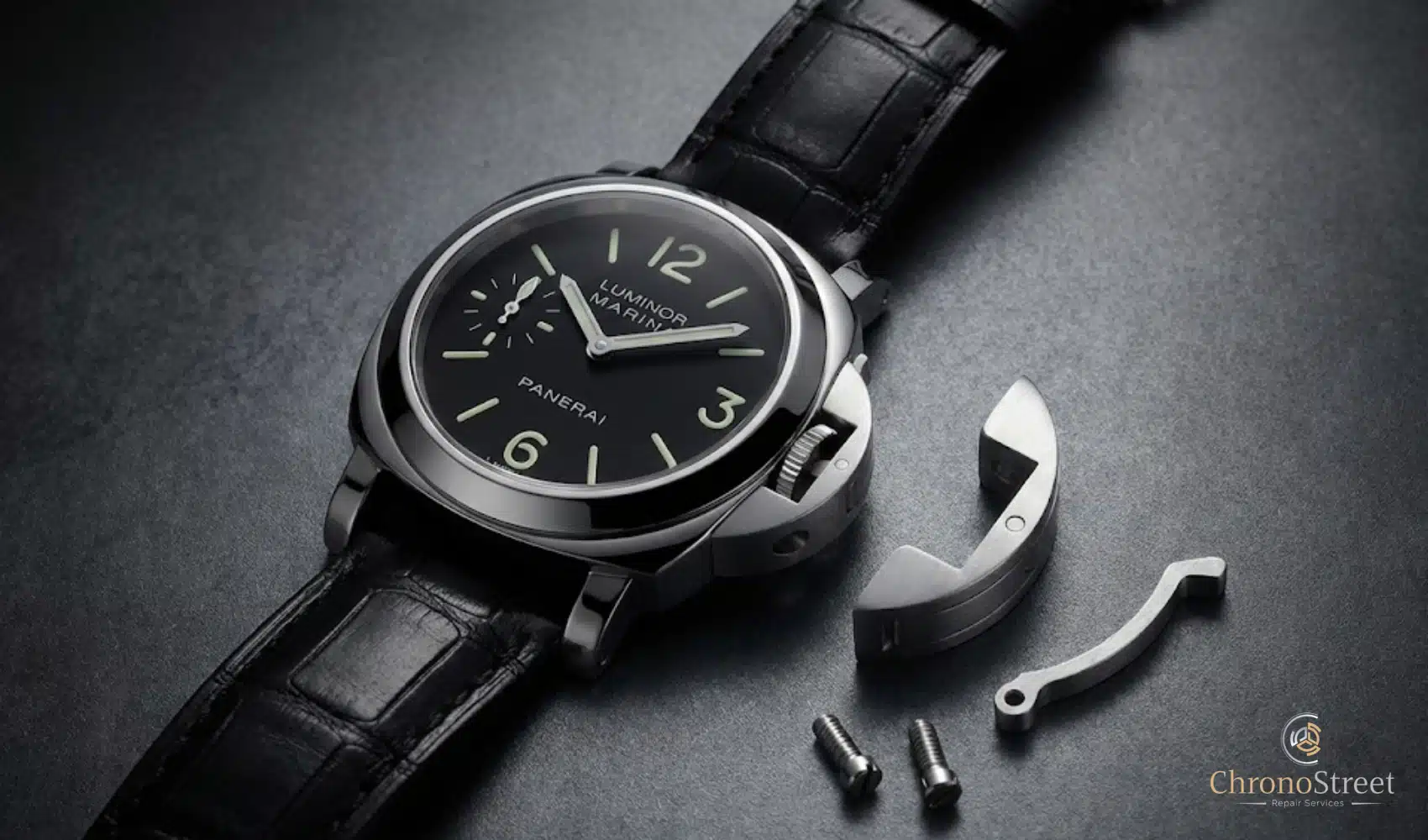
- Wobbly Bridge: The entire steel block, also called the bridge, moves when you touch it, which means the mounting screws that attach the guard to the case are loose. Remember, this is very common because the vibration of wearing the watch can loosen these screws over time.
- Floppy Lever: The bridge is tight, but the locking lever itself dangles or does not “snap” shut with tension. So, this is a more complex issue involving the lever pin or wear on the eccentric cam, the part of the lever that pushes the crown.
Tools Required for the Repair
You must have the correct watchmaking tools to repair the crown guards on your Panerai watch.
- Precision Screwdriver (1.6mm): Most Panerai Luminor models, such as 44mm and 47mm, use screws with a slot that fits a 1.6mm blade perfectly. Some smaller models or specific 1950 cases require a 1.4mm screwdriver. Ensure the blade is “hollow ground” (T-shaped) rather than wedge-shaped to prevent slipping.
- Threadlocker (Loctite 222): Don’t use strong industrial glue. Instead, you need Loctite 222, such as the purple one with low strength, or Loctite 243, which is the blue one with medium strength. We prefer the purple one for small watch screws.
- Masking Tape: You need masking tape to protect the polished or brushed finish of the case.
- Tweezers: Non-magnetic brass or plastic tweezers are the best.
- Magnifying Loupe: You need this to inspect the thread condition.
Step-by-Step: Fixing Loose Bridge Screws
Keep in mind that this is the most frequent repair, and if your crown guard is wobbling, follow these steps:
Step 1: Preparation and Protection
First, place the watch on a soft or microfiber cloth. Take a piece of masking tape and apply it around the area of the crown guard. If your screwdriver slips, it will hit the tape, not the steel case.
Step 2: Check the Screw Size
Test your screwdriver in the screw head without turning. It must fill the slot, and if there is wiggle room, it means the blade is too small. For example, using a 1.2mm driver on 1 1.6mm screw will deform the screw head and make it look ugly. Remember, this reduces the watch’s resale value.
Step 3: The Tightening Process
If the screws are just slightly loose, you may torque them down. We strongly recommend “not doing this.” Instead, unscrew both bridge screws completely and remove the crown guard. Clean the threads of the screws and the case holes with alcohol to remove old grease or dirt. Next, check the winding stem tube. Sometimes, dirt accumulates here, preventing the guard from sitting flush.
Step 4: Apply Threadlocker
Apply a tiny dot of Loctite 222 to the tip of the screw threads. Don’t drown it. You only need enough to stop the vibration from loosening it again. Place the crown protector back onto the case, insert the screws, and tighten them finger-tight. There is no official public number for the torque, but the rule of thumb is “snug plus 1/8th of a turn.” Don’t over-tighten, or you will strip the threads in the case, which is catastrophic failure requiring laser welding to fix.
Fixing a Loose Locking Lever
The fix is different if the bridge is tight, but the lever has no tension.
The Lever Pin Issue
A simple steel pin holds the lever on older Pre-V and some A-series to G-series models. The hole in the lever can stretch over years of opening and closing. Or the pin can wear down. You can use the “Hot Glue” trick, which requires you to remove the lever pin using a pin pusher, clean the lever, and apply a micro-film of hot glue or clear epoxy inside the pin hole. When reassembled, this adds just enough friction to stop the lever from dangling. Remember, this is not a factory fix, but it works for loose pins.
The Roller Lever Difference
Modern Panerai watches, such as post-2007 and 1950 cases, use a lever with a small roller built into the cam, which creates a smoother action. However, if this lever becomes loose, it usually means the roller itself is worn, or the spring-loaded ball bearing in some automatic models is stuck. You can’t easily tighten a roller lever. According to our luxury watch servicing experts, If it has lost tension, it usually means the metal has fatigued. So, you must source a replacement lever or a complete aftermarket crown guard.
Common Mistakes to Avoid
- Wrong Screw Length: If you buy aftermarket screws, such as those sold as “44mm Panerai screws,” make sure you measure them, and they must typically be around 4.2mm in total length. On the other hand, if they are too long, they will bottom out before securing the bridge. If too short, they will strip the first few threads of the case.
- Forgetting the Gaskets: When you remove the guard, ensure you don’t damage the crown tube gasket. The lever works by axial compression and pushes the crown into the gasket. Tightening the guard will not restore water resistance if the gasket is dry or cracked.
- Over-Torqueing: The steel of the screw is often harder than the threaded hole in the case, and you will destroy the case threads if you force it.
Also Read: Panerai Watch Service: Everything You Should Know
Final Words
Although fixing a loose Panerai crown guard is a satisfying task, you must do it with patience. Use the correct 1.6mm screwdriver, apply the right threadlocker, and respect the mechanics of the device, which protects the crown. That way, you can restore the solid tank-like feel that these watches are famous for.