

The Debate on Polishing a Watch
Getting a scratch on a beautiful watch is a painful experience for any owner. And naturally, the first thought is to fix it. However, the “fix” can sometimes cost you more money in the long term than the damage itself.
Therefore, you must understand what watch polishing actually is. Polishing does not mean simple cleaning. In fact, it is a professional resurfacing process, which involves removing a microscopic layer of metal from the watch case and bracelet. The purpose is to erase scratches.
Polishing is one of the most debated topics in horology because material is permanently taken away. Although it can restore “new-like” shimmer, it is an irreversible action. Depending on the age and rarity of your watch, this process can either help you or become a “value killer.”
Why Polishing Can Increase a Watch’s Value
Polishing is usually a good idea if you own a modern pre-owned watch. The average buyer of modern luxury watches expects a scratch-free finish that looks like a showroom purchase.
Restoring Shelf Appeal: Most casual buyers of modern models, such as the standard Rolex Datejust or Omega Seamaster, prefer a pristine look. Polishing removes surface blemishes and hairline scratches. It gives the watch a competitive edge in the secondary market.
Sign of Maintenance and Care: A professional watch polishing service can make a difference. For example, a polished watch shows that the owner has invested in regular servicing. It creates a strong connection between a beautiful exterior and a healthy internal mechanical movement. Removing deep chips also protects the watch from dirt and moisture.
Moreover, the impact of professional finishing is very clear with a complex design. According to the market experts, an Audemars Piguet Royal Oak with an average value of roughly $49,000 can have a big price difference based on its condition. For instance, the Royal Oak has a signature octagonal bezel and sharp architectural lines, and restoring a beat-up watch to its factory finish can increase its resale return on investment (ROI).
Why Polishing Can Decrease Value
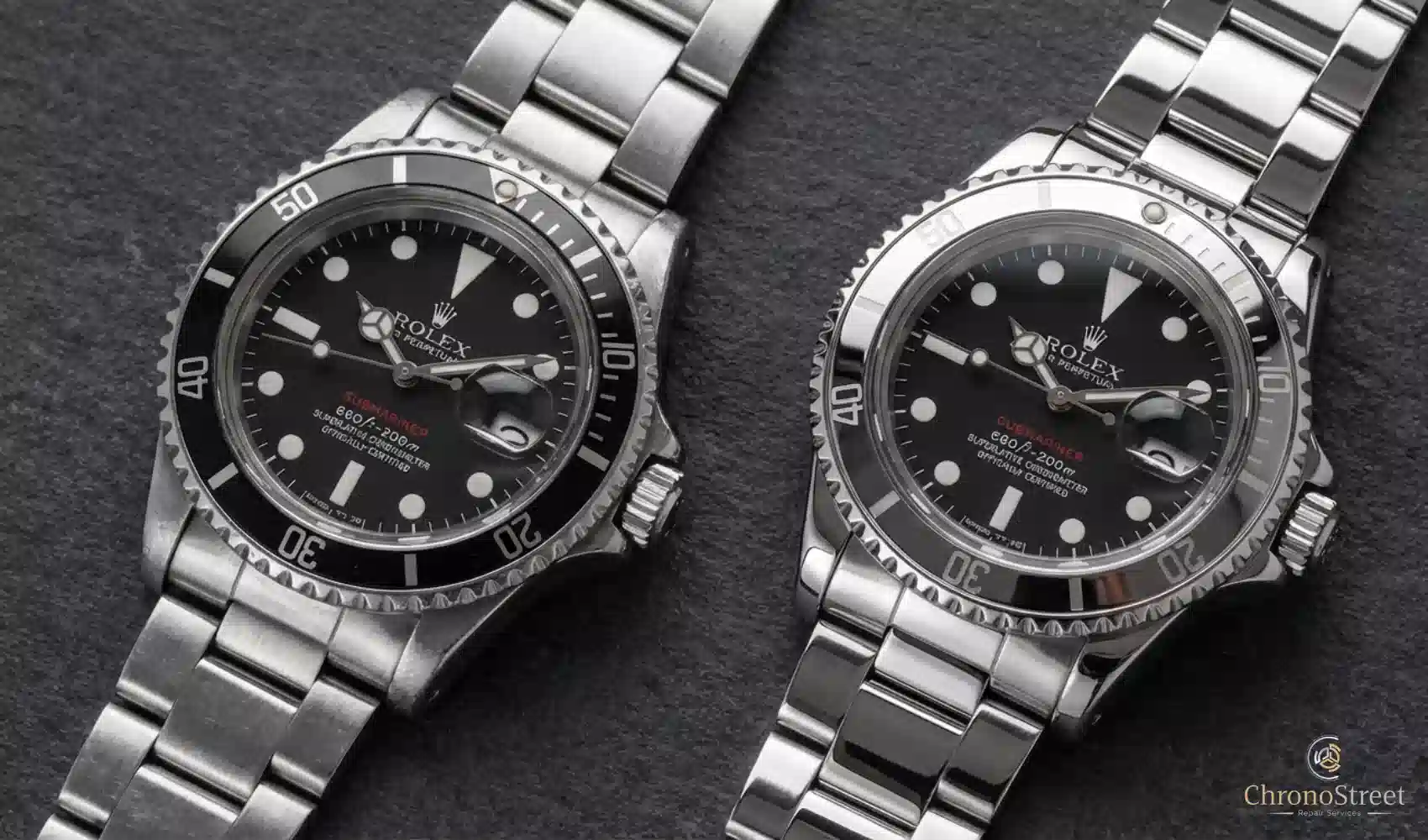
Making an old object look new can destroy its worth. That’s a fascinating paradox in the luxury watch world. Serious collectors often see a polished vintage watch as damaged. When a watch leaves the factory, it has specific geometric proportions. Collectors prize “unpolished” or “sharp” cases where the factory lines, bevels, and chamfers remain completely untouched.
Material Loss and Case Thinning: Every polish removes metal. Over time, over-polishing can cause thin lugs and rounded edges. Therefore, the watch loses its architectural shape and starts to look like a worn-down bar of soap. Once this metal is gone, it can never be restored normally.
The Patina Factor: If you are a vintage collector, scratches and oxidation (Patina) are not damage for you. In fact, they are a story because they prove the historical honesty of the piece. On the other hand, a perfect, shiny 1950s watch often looks suspicious to an expert.
Extreme Value Drop Examples: The market pays a massive premium for rarity. An unpolished Rolex Paul Newman Daytona famously sold for $17.75 million. If that same watch had been polished, it would sell for a small fraction of that price. Similarly, unpolished examples of Patek Philippe Reference 1518 always achieve record-breaking sales compared to restored ones.
How to Spot an Over-Polished Watch
Spotting an over-polished watch requires you to look closely at the original geometry. Here are the primary red flags:
- Rounded Lugs: Look at the arms of the watch case. The watch is over-polished if the arms have lost their shape or needle-like points.
- Blurred Hallmarks and Serial Numbers: Polishing too close to engravings makes the numbers and brand stamps look faint or disappear entirely.
- Vanishing Chamfers or Bevels: Many classic sports watches have a unique 45-degree angle edge. The watch has lost its original silhouette if this chamfer is missing or uneven.
- Melted Crown Guards: The guard protecting the crown should be sharp. However, if they look like melting ice cream or are not symmetrical, this means too much metal was removed.
- Protruding End-Links: If the metal of the lug is thinner than the bracelet end-link, it means the lug was heavily polished down.
- Inconsistent Finishing: A big mistake is when a brushed metal surface is accidentally polished to a mirror shine, or when the clasp logo looks flat and faded away.
To Polish or Not to Polish?
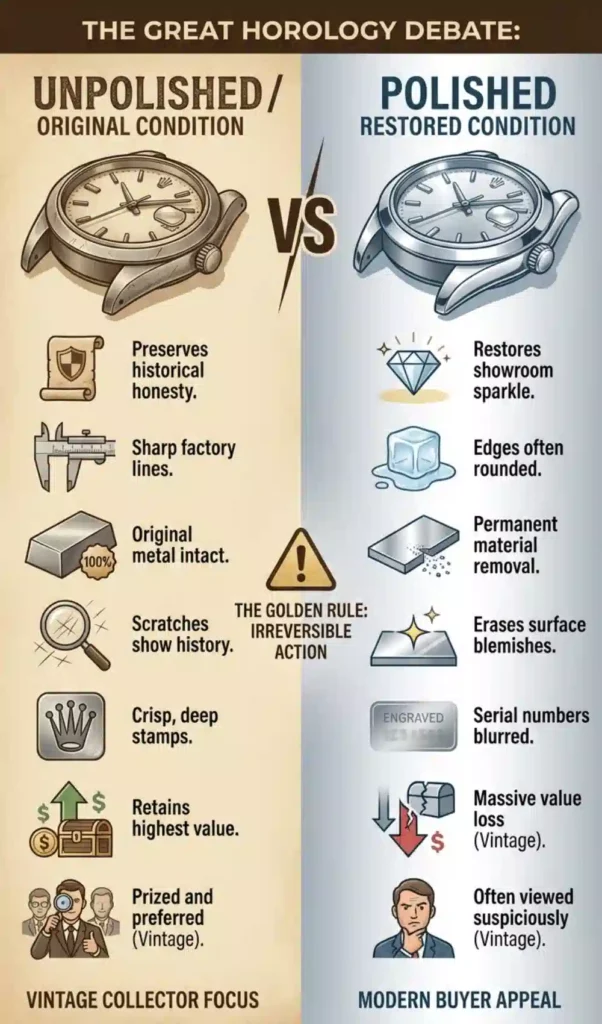
Deciding to polish your luxury watch is a balance between your personal aesthetic preference and financial value.
When to Say Yes
- If you wear a modern Rolex or Omega every day, keeping it pristine is widely accepted.
- Your watch needs professional service if deep dents compromise the integrity or symmetry of the case.
- Say “Yes” if an Authorized Service Center (ASC) performs the job every 7 to 10 years during a full movement service.
When to Say No
- Never polish watches that are 20 to 30+ years old. You will lose the patina and lower the value.
- Complex hand-finished watches lose massive collector appeal if altered.
- Precious metal watches like Cartier in white gold have strict lifetime polishing limits to prevent material thinning. .
Also Read: DLC vs PVD Coating for Watches
Remember The “Once It’s Gone, It’s Gone” Rule
The golden rule of watch collecting is very simple. You can always polish a watch later, but you can never “un-polish” it. Once you shave off the factory bevels, there is no undoing the damage to the watch’s original value.
Therefore, as a final recommendation, always start with deep cleaning instead. Professional watch cleaning and servicing restores enough sparkle to satisfy you because experts use an ultrasonic cleaner for the metal bracelet without putting the watch head inside.
An expert watchmaker also uses a soft-bristled brush with mild soap for the case or a product like Polywatch if your watch has a scratched plastic crystal. The purpose is to restore clarity without touching the metal.