

| Standard | ISO 3159:2009 |
| What gets tested | The movement, usually before casing |
| Accuracy required | -4 to +6 seconds per day, averaged |
| Who certifies it | COSC and other approved observatories |
What is a Chronometer?
The word comes from the Greek chronos (time) and metron (measure). “Precise” describes how a watch performs. “Chronometer” describes a status it was granted. A watch running at one second a day with no certificate is not a chronometer. A certified watch that has drifted to 8 seconds a day still is one, because certification records what the movement did during a test.
The word is controlled in Switzerland. A brand can’t print “Chronometer” on a dial unless the watch has a valid certificate. Most other markets have no such rule, which is why the term shows up loosely in advertising outside Swiss watchmaking.
How a Watch Earns the Certification?
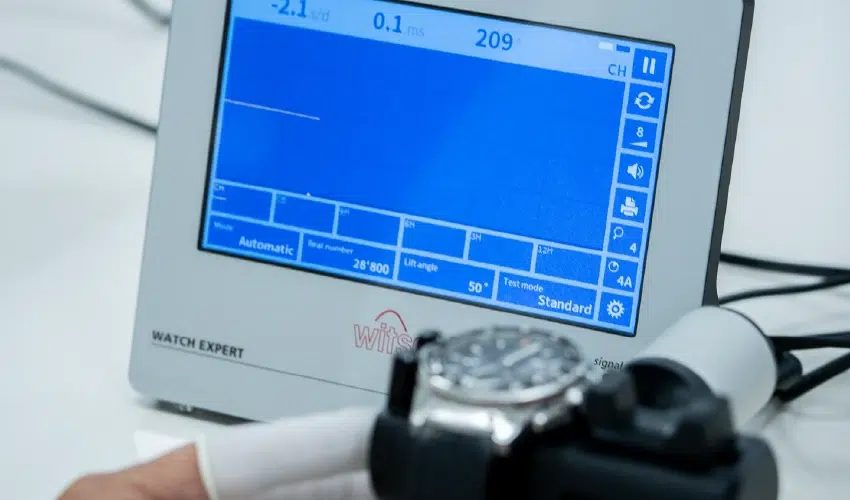
Certification takes 15 days. The movement is limited in 5 positions and at 3 temperatures: 8 degrees, 23 degrees, and 38 degrees Celsius. Testing the same movement lying flat and standing on edge shows whether gravity changes its rate. Most watch enthusiasts say the -4/+6 figure. However, according to Aiman Moner, our watch authentication and repair expert, there are seven criteria in total:
- Average daily rate
- Mean variation in rates
- Greatest variation in rates
- Difference between horizontal and vertical positions
- Largest variation in rates
- Rate variation with temperature
- Rate resumption, which means the movement returns to its original rate after being pushed
The -4/+6 number is an average. It is not a daily promise. Moner says it is calculated across several days of reading. A certified watch can run +9 seconds one day and -1 the next and still pass. If your certified watch gains 6 seconds on Tuesday, nothing is wrong with it. This single point causes more confusion among owners than any other.
Quartz movements can be certified too. The limits are far tighter: -+0.07 seconds per day at 23 degrees Celsius, and -+0.2 seconds at 8 degrees and 38 degrees Celsius.
What Changed in 2026
Chronometer certification meant one thing for 50 years. That changed this year. In February 2026, COSC announced Excellence Chronometer Certified, a second tier above the existing standard. It tests the finished, cased watch rather than the bare movement. A movement first passes the usual 15-day ISO 3159 test, goes back to the manufacturer to be cased, then returns for 5 more days of testing. Those 5 days include a robot simulating 24 hours of real wrist movement.
The requirements are tighter: -2 to +4 seconds per day, 6 semi-dynamic positions instead of 5 static ones, magnetic resistance to 200 gauss, and verification that the watch delivers the power reserve the brand claims. There are eight criteria instead of seven. Every watch is tested individually. Pilot testing began in March, with full rollout expected through the year.
Rolex moved in the same direction. In 2026, the brand added three criteria to its Superlative Chronometer certification: resistance to magnetism, reliability, and sustainability. These are alongside the 2015 criteria, which cover precision, waterproofness, self-winding, and power reserve. Accuracy after casing is at -2 to +2 seconds per day.
| Certification | Tested on | Seconds per day | Magnetism |
| COSC Certified Chronometer | Uncased movement | -4 to +6 | Not tested |
| COSC Excellence Chronometer | Cased watch | -2 to +4 | 200 gauss |
| METAS Master Chronometer | Cased watch | 0 to +5 | 15,000 gauss |
| Rolex Superlative Chronometer | Cased watch | -2 to +2 | Yes |
Movement vs. Watch
A standard COSC certificate describes a movement on a test bench. The watch on your wrist is a different object. Casing adds 3 things that change how a movement behaves. Steel and other case parts can have magnetic influence, and magnets are everywhere now, from laptop lids to bag clasps, says Aiman Moner.
A bracelet adds weight that changes which position the watch rests in most of the day. And the assembled watch reacts to heat differently than a bare movement does. This explains the last 11 years of the industry. Omega launched METAS Master Chronometer testing on cased watches in 2015, with resistance to 15,000 gauss.
Rolex redefined the Superlative Chronometer the same year, moving its own testing to finished watches. COSC followed in 2026. Three separate announcements, one shared conclusion: certifying a movement was never the same as certifying a watch.
Also Read: How Much Does it Cost to Service a Rolex Watch
Chronometer vs. Chronograph
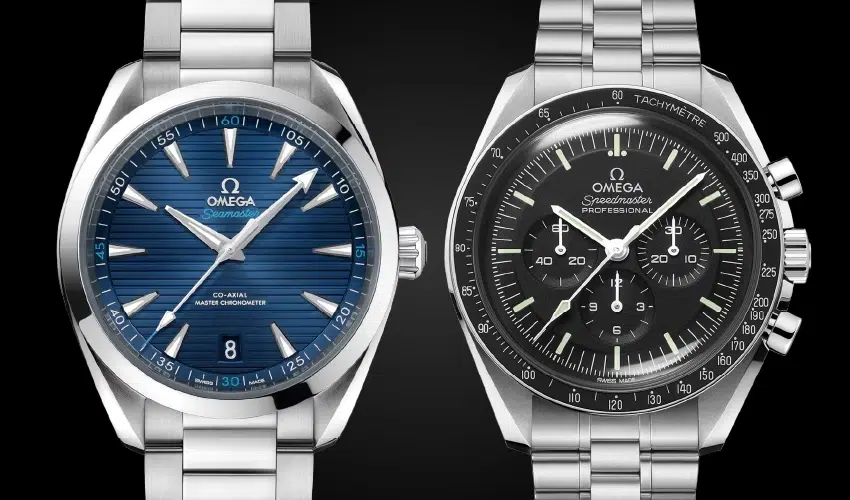
These two words get swapped constantly because they share a prefix. A chronometer is a rating, which means the timekeeping has been certified. A chronograph is a function, which is a built-in stopwatch, started and stopped with pushers on the case. A watch can be both. An Omega Speedmaster Moonwatch Master Chronometer times laps and has a certificate. Chronometry, a third term you may see, is the science of measuring time.
Marine Chronometers and Longitude
The word exists because of a navigation problem. Sailors could find latitude from the sun, but longitude required knowing the exact time at a fixed reference point. Every 4 seconds of clock error put a ship about one nautical mile off course at the equator.
John Harrison solved it with H4, a sea clock that proved itself on an Atlantic crossing in 1761. Marine chronometers became survival equipment, then the subject of observatory accuracy competitions, and eventually the certification labels used today. That history is why the word still has the weight of institutional testing, and why “precise” has never been a substitute for it.
Who Else Can Certify a Chronometer
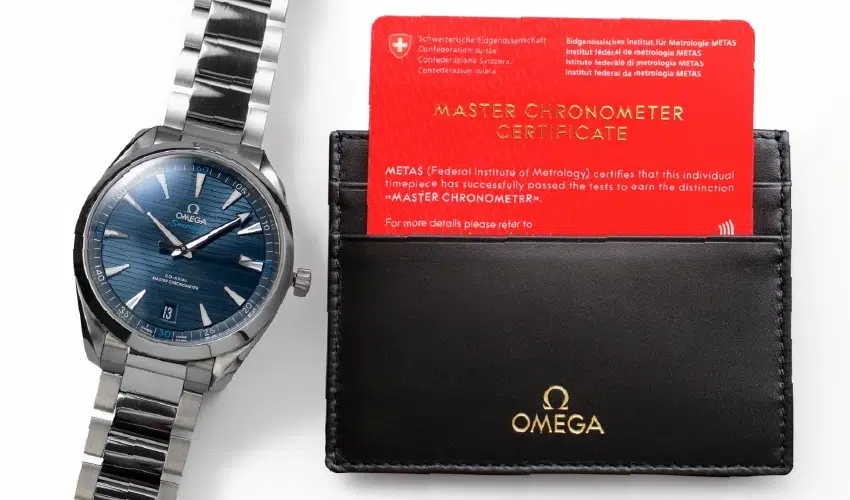
COSC is the largest organization or body, but it is not the only one. Other includes:
- Observatoire de Besancon in France
- Glashutte Observatory in Germany
- Japan Chronometer Inspection Institute
- Timelab in Geneva
- METAS, which is the Swiss federal metrology institute
Qualite Fleurier requires passing the COSC test and a 24-hour wear simulation, a 0 to +5 daily rate, and finishing quality standards. Plenty of brands build movements that meet or beat chronometer tolerances and never apply for certification, because it adds cost and weeks of delay without adding any function. A certificate proves accuracy. Its absence does not disprove it.
Is a Chronometer Important for You?
It depends on how you use a watch. If you wear one casually and reset it against your phone every week or two, certification won’t change your experience. A well-regulated uncertified watch and a certified one feel the same in daily use.
If you are choosing between two watches at a similar price, the certified one comes with documented quality control and usually a stronger resale story. If you work around magnetic fields, this is where the specs are important. METAS-level testing to 15,000 gauss protects against something you will encounter, and it is the one figure here that changes the real outcome.